Epoxy Tile Grout vs. Cement Tile Grout: The Truth About Durability and Stains
AuthorcarboAdmin
Published
Epoxy Tile Grout vs. Cement Tile Grout
Whether you are a homeowner renovating a kitchen or a project manager overseeing a commercial hospital wing, the “grout debate” is one you cannot ignore. For decades, traditional cement-based grout was the only player in the game. However, with the rise of high-performance construction chemicals, Grout has emerged as the definitive solution for those seeking long-term durability and a stain-free finish.
As an established manufacturer with over 15 years of experience and 10,000+ projects delivered, Carbolink Construction understands that the wrong grout can ruin a beautiful tile installation. In this guide, we dive deep into the technical reality.
1. The Composition: Porous vs. Non-Porous
Cement Grout: The Traditional Choice
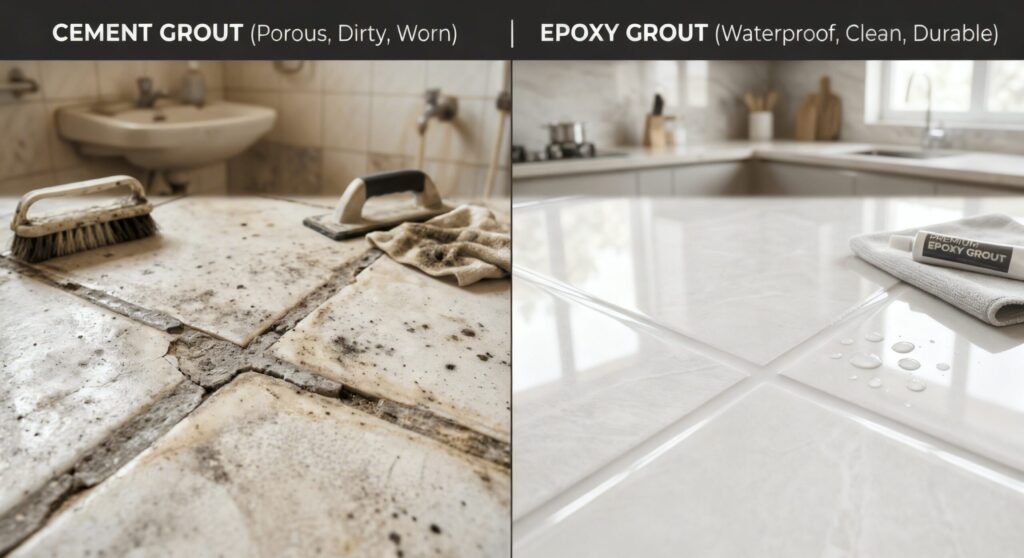
Cement grout is a mixture of water, cement, and often sand. While it is affordable and easy to apply, it is inherently porous. Think of it like a hard sponge. Because it has microscopic holes, it naturally absorbs water, grease, and bacteria over time.
Epoxy Tile Grout: The Engineering Marvel
Unlike cement, Epoxy Tile Grout is made from epoxy resins and a filler powder. When these components are mixed, a chemical reaction occurs, creating a surface that is completely non-porous. It does not absorb liquids, making it naturally waterproof and highly resistant to chemicals.
2. The Battle of Durability: Which Lasts Longer?
When we talk about durability, we are looking at how well the material handles structural movement, heavy foot traffic, and harsh cleaning agents.
Structural Strength:Epoxy Tile Grout acts almost like a secondary adhesive. It has a high compressive strength that helps bond tiles together, reducing the risk of cracking in high-traffic areas.
Shrinkage: Cement grout often shrinks as it cures, leading to hairline cracks. Epoxy Tile Grout does not shrink, ensuring the joints remain full and intact for years.
Chemical Resistance: In environments like commercial kitchens or laboratories, acidic cleaners will eventually eat away at cement grout. This is designed to withstand harsh industrial chemicals and acidic food spills without degrading.
3. The Truth About Stains and Hygiene
This is where the difference becomes visible to the naked eye. Have you ever noticed white grout turning grey or yellow in a bathroom? That is because cement grout is absorbing dirt and soap scum.
Because Epoxy Tile Grout is non-absorbent, stains stay on the surface rather than soaking in. This makes it:
Stain-Proof: Coffee, wine, and grease can be wiped away with a damp cloth.
Mould and Mildew Resistant: Since water cannot penetrate the grout, there is no damp environment for mould to grow. This makes it the “Gold Standard” for bathroom waterproofing.
Color Consistency: Cement grout can often look “patchy” if the water-to-powder ratio isn’t perfect during mixing. Epoxy Tile Grout provides a uniform, vibrant color across every joint.
4. Cost vs. ROI: Is the Investment Worth It?
There is no hiding the fact that Epoxy Tile Grout is more expensive upfront than cement grout. It also requires a more skilled application, as it sets faster and is harder to clean off tile surfaces during installation.
However, consider the Total Cost of Ownership:
Zero Sealing Required: Cement grout must be sealed every year to remain somewhat water-resistant. Epoxy Tile Grout never needs sealing.
No Regrouting: Because it doesn’t crack or fall out, you won’t need to regrout your tiles after 5 years.
Easier Maintenance: You save hours of scrubbing with harsh chemicals.
For a busy Indian household or a high-standard commercial facility, the ROI on Epoxy Tile Grout is achieved within the first few years.
5. Why Choose Carbolink’s Epoxy Tile Grout?
At Carbolink, we don’t just supply grout; we manufacture high-performance chemical systems. Our Epoxy Tile Grout is part of our “Made in India” initiative, engineered specifically for our tropical climate.
High Workability: We have formulated our epoxy grout to be easier for contractors to apply, giving them more “open time” to clean the tiles.
Vibrant Color Range: We offer a variety of shades that match popular Indian tile brands and our own architectural textures.
System Synergy: For the best results, we recommend using our TA C-3 Advanced Tile Adhesive as the base, followed by our epoxy grout for a completely waterproof system.
Conclusion: The Final Verdict
If you are looking for a quick, low-budget fix for a dry area with low traffic, cement grout might suffice. But if you want a permanent, stain-proof, and hygienic solution for your kitchen, bathroom, or industrial floor, Epoxy Tile Grout is the only choice.
Don’t let dirty grout lines ruin your beautiful tiles. Invest in the durability of Carbolink today.