

Industrial Epoxy Flooring vs. Industrial Polyurethane (PU) Flooring
In the demanding world of industrial operations, the floor is more than just a surface—it is a critical piece of infrastructure. Whether you are managing a heavy-duty manufacturing plant, a sterile pharmaceutical lab, or a high-traffic warehouse, your flooring must withstand mechanical stress, chemical exposure, and constant abrasion.
As a leading manufacturer of over 200 construction chemicals, Carbolink has executed over 10,000 projects across India, providing us with a deep technical understanding of how these materials perform in real-world conditions. In this guide, we compare Industrial epoxy flooring and PU flooring across all technical parameters to help you make an informed decision for your facility.
1. Defining the Systems: Epoxy vs. Polyurethane
What is Industrial Epoxy Flooring?
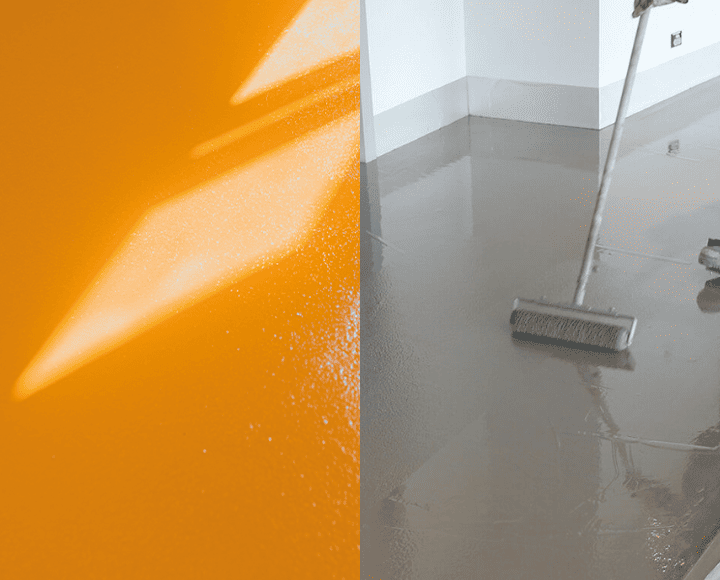
Industrial epoxy flooring is a thermosetting resin that is applied as a multi-coat system. It consists of two main components: a resin and a hardener. When mixed, a chemical reaction occurs that creates a rigid, plastic-like surface that bonds incredibly well to concrete substrates.
Key Characteristic: High compressive strength and exceptional bond to the base.
What is Industrial Polyurethane (PU) Flooring?
PU flooring is also a multi-component system, but it results in a more flexible, elastic finish compared to epoxy. It is often referred to as a “point-elastic” surface.
Key Characteristic: Excellent flexibility and superior resistance to thermal shock and impact.
2. Technical Performance: Durability & Resistance
Mechanical Strength & Abrasion
Industrial epoxy flooring is known for its extreme hardness. It has a high “Shore D” hardness rating, making it ideal for heavy-duty warehouses where forklifts and pallet jacks move heavy loads constantly. However, because it is rigid, it can be prone to cracking if the underlying concrete moves or if heavy objects are dropped from a height.
PU flooring, being more “rubbery” in its molecular structure, is much more resistant to impact. If a heavy tool is dropped, the PU floor “gives” slightly and returns to its shape, whereas Industrial epoxy flooring might chip.
Chemical & Thermal Resistance
- Epoxy: Generally offers excellent resistance to a wide range of industrial chemicals, including oils, detergents, and many acids. This makes Industrial epoxy flooring the standard for automotive workshops and general manufacturing.
- PU: Is the king of thermal shock resistance. In industries like food processing or cold storage where floors are steam-cleaned or subjected to extreme temperature shifts, PU floors outlast epoxy.
3. Aesthetic & Functional Finishes
Both systems can be customized with various additives to meet specific industry needs:
- Anti-Skid Texture: By broadcasting quartz sand into the base coat, both Industrial epoxy flooring and PU systems can be made slip-resistant, essential for safety in wet areas like car parks or bottling plants.
- Hygienic/Seamless: Both are seamless, preventing bacteria from growing in joints—a mandatory requirement for “Green Building” and pharma standards.
- Gloss Levels: Industrial epoxy flooring typically offers a high-gloss, reflective finish that improves facility lighting. PU systems usually have a more muted, matte finish.
4. Industry-Specific Recommendations
| Industry | Recommended System | Why? |
| Warehousing & Logistics | Industrial Epoxy Flooring | High compressive strength for heavy forklift traffic. |
| Food & Beverage / Dairies | Polyurethane (PU) | Resistant to organic acids and thermal shock from hot water washing. |
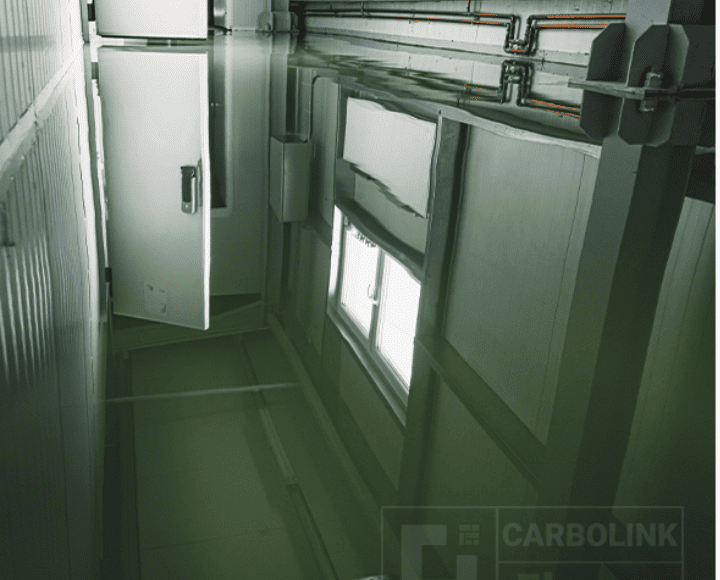
| Pharmaceuticals | Self-Leveling Epoxy | Creates a high-gloss, ultra-hygienic, and seamless environment. |
| Car Parks & Ramps | PU Topcoats | Flexibility handles structural movement; UV stability prevents fading in open areas. |
5. Budget & ROI: The Cost of Ownership
When choosing between Industrial epoxy flooring and PU, the initial cost is only one part of the equation.
- Initial Cost: Generally, Industrial epoxy flooring is more budget-friendly per square foot for standard applications. PU systems involve more complex chemistry and are often more expensive to install.
- Maintenance: Epoxy is easier to clean but may require more frequent “patching” if it chips. PU lasts longer in high-impact or temperature-varying environments, providing better long-term ROI in those specific sectors.
6. The Carbolink Advantage: Excellence in Every Layer
As a direct manufacturer, Carbolink provides specialized formulations that standard contractors cannot match:
- Solvent-Free Systems: Many of our Industrial epoxy flooring systems are solvent-free, making them safe for application in enclosed spaces without the risk of toxic fumes.
- Custom Colors: We offer a wide range of RAL and Asian Paints equivalent colors to match your corporate branding.
- Technical Support: We don’t just sell the product; we provide site evaluations to ensure the sub-base is correctly primed using our specialized concrete densifiers and primers.
Conclusion: Which One Should You Prefer?
- Prefer Industrial Epoxy Flooring if: You have a dry, indoor facility with heavy mechanical loads (forklifts), and you want a high-gloss, cost-effective, and durable finish.
- Prefer PU Flooring if: You operate in a “wet” industry, deal with extreme temperature changes (thermal shock), or need a floor that can handle structural vibration and impact.
Get a Professional Consultation Today
Unsure which system fits your specific site conditions? Let the experts at Carbolink India help.
📞 Call/WhatsApp: +91 88850 99551 / +91 90304 32769