
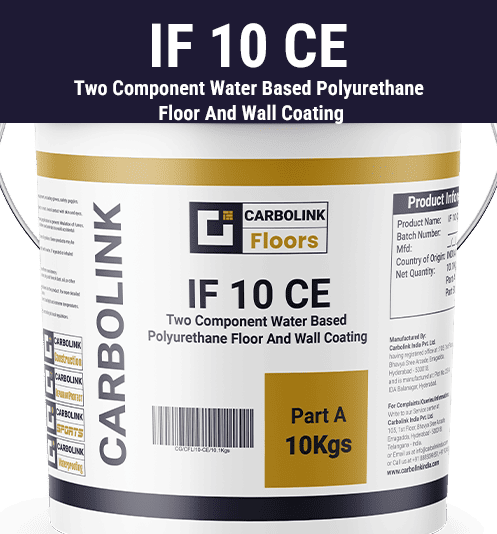
Features
For floors and walls Very high chemical resistance Hard wearing Hygiene Easy cleaning Anti-fungal, anti-bacterial.
Application
The mixed material should be applied without delay to the prepared substrate using a brush, roller, or rubber squeegee, depending on the thickness and finish required.
Physical Properties
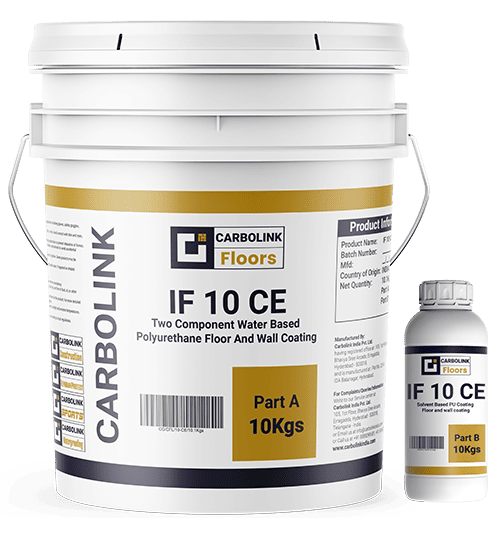
IF 10 CE – @27±1°C
| # | characteristic | value |
|---|---|---|
| 1 | Working time | 30 to 45 minutes |
| 2 | Mixed Density | 1.15 to 1.25 g/cc |
| 3 | Light traffic | 24 hours |
| 4 | Full Traffic | 48 hours |
| 5 | Full chemical cure | 7 days |
| 6 | Mixing Ratio | As specified on the container |
| 7 | Bond strength at 24 hours | Concrete – > 2 N/mm² Epoxy – > 2 N/mm² Polyurethane – > 2 N/mm² |
| 8 | Flexural Strength | 11 N/mm² |
| 9 | Konig pendulum hardness DIN EN ISO 1522 | After 7 days curing at 23°C and 50% RH 120μm wet film thickness on glass – 92s |
| 10 | Pencil hardness (gouge) ISO 15184:1998 | After 7 days curing at 23°C and 50% RH 120μm wet film thickness on glass – >= 2H |
| 11 | Gloss (60°/85°)% ISO 2813:1978 | After 7 days curing at 23°C and 50% RH 120μm wet film thickness on glass – 4.5/8.9 |
| 12 | Impact (kg.cm) ASTM2794 | After 7 days curing at 23°C and 50% RH 23μm film thickness on tin-steel – >= 50 |
| 13 | Bend (mm) ISO 1519 | After 7 days curing at 23°C and 50% RH 23μm film thickness on tin-steel – <= 1 |
| 14 | Abrasion ASTM D 4060 | CS 10 abrading wheel / 10 N load, 1000 cycles Taber abrader after 7 days curing at 23°C and 50% RH – ~ 50 mg |
| 15 | Alcohol (100%) double rub | 200 cycles, 350g load (120μm wet film thickness on glass, 7 days curing at 23°C and 50% RH) – > 200 |
| 16 | MEK double rub | 350g load (120μm wet film thickness on glass, 7 days curing at 23°C and 50% RH) – > 200 |