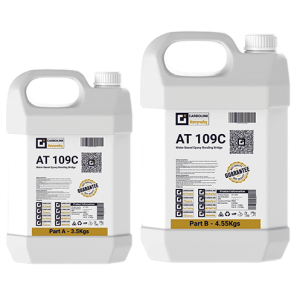

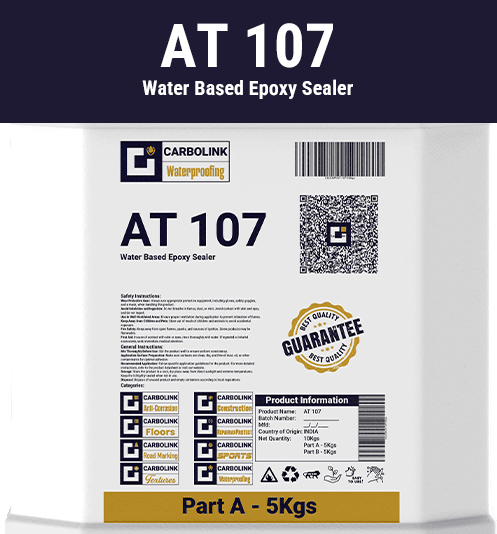
Key Features
- Applicable to wet or damp surfaces free from running or ponding water.
- Safe for use on freshly laid hardened (green) concrete.
- Tolerant of surfaces with subpar preparation.
- Seals and stabilizes dusty or loosely bound surfaces.
- Exceptional adhesion to various substrates, including brick, masonry, concrete block, concrete, compressed fiberboard, stone, and timber.
Benefits
It can be applied to wet or damp surfaces without running or ponding water.
Suitable for newly laid, hardened concrete.
Strengthens weak or rain-affected concrete surfaces, creating a stable base for further treatments.
Excellent penetration even into fine-grained substrates like high-strength concrete.
Effective on surfaces with insufficient preparation.
Seals and consolidates dusty or loosely bound surfaces.
Strong adhesion to various substrates, including brick, masonry, concrete block, concrete, compressed fiberboard, stone, and timber.
Non-flammable with minimal odour.
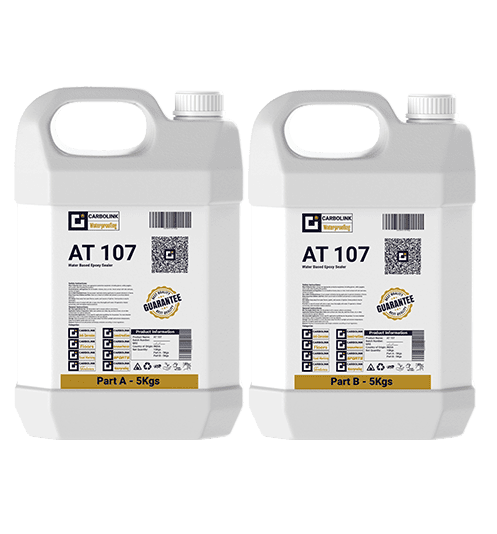
Convenient 1:1 mixing ratio.
Water-based for easy cleanup.
Safe for use in sensitive environments such as around food or living areas.
Recommended Uses
As a penetrating sealer to enhance bonding to high-strength concrete or other fine-textured surfaces.
It is used as a consolidating sealer for aged concrete before applying other covering or coating systems.
As a bonding agent for surfaces at risk of grease or oil contamination.
As a consolidating sealer for rain-affected concrete to form a stable base.
It is a waterproofing sealer for concrete, masonry, brickwork, fibre cement, plywood, and particleboard in wet areas.
As an industrial dust suppressant and sealer for warehouse and factory floors where colour is not a concern.
Limitations
Do not apply when the surface temperature is below eight °C, above 35°C, or relative humidity is above 90%.
Curing reaction halts at temperatures below eight °C, resuming slowly as the temperature rises above 8°C.
Ensure proper ventilation during drying and curing.
Not stable under ultraviolet light unless submerged.
It is only suitable as a sealer when used on trafficable surfaces.
Avoid sandwiching water—or solvent-based adhesives between AT 107 and lowpermeability floor coverings. Instead, use cement based ceramic tile adhesives.
Surface Preparation
1.Ensure all surfaces are structurally sound and free from contaminants.
2. Remove all existing coatings before applying AT 107, and open the concrete pores as much as possible using high-pressure water blasting or abrasive blast cleaning.
3. Thoroughly remove all concrete curing membranes or form release agents before application.
4. Allow AT 107 about 1.5 hours to penetrate, then overcoat with a thin layer of AT 108 Water- Based Epoxy Membrane at a coverage rate of 10 square meters per litre.
Technical Data
| # | Characteristic | Value |
|---|---|---|
| 1 | Colour | Red-colored transparent |
| 2 | Finish | Clear gloss, which darkens and becomes matte with ageing |
| 3 | Volume Solids | 22 ± 2% |
| 4 | Mixing Ratio | 1:1 (Part A / Part B) by volume |
| 5 | Pot Life | 4 hours at 25°C |
| 6 | Number of Coats | 1-2, depending on application purpose |
| 7 | Recoat Time | 1.5 hours at 25°C and 50% R.H. |
| 8 | Full Cure | 7 days at 25°C and 50% R.H. |